
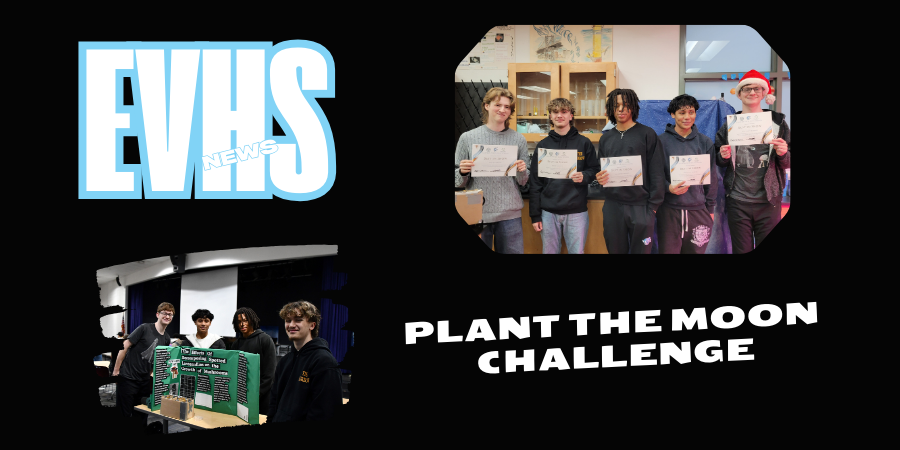
Science students at Eastern View High School are reaching for the stars, literally, through their participation in the Fall 2025 Plant the Moon Challenge, a global science and research initiative focused on growing crops in simulated lunar soil.
Under the guidance of science teacher Rachel Stuart, students spent eight weeks designing and conducting experiments using lunar regolith simulant, the same type of material scientists use to replicate the surface of the Moon. The project culminated in a Plant the Moon Science Fair held on Friday, November 21, 2025, in the EVHS forum, where students presented their findings to classmates, teachers, and central office staff.
Throughout the challenge, students applied the scientific method while tackling real-world problems faced by scientists working toward future space exploration. Teams tested soil macronutrients, addressed issues such as fungal growth and insect contamination, and worked through the complexities of proper watering in a nontraditional growing medium.
“This experiment pushes students to think critically and collaboratively,” Stuart said. “They’re not just following a set of instructions, they’re troubleshooting, adapting, and learning how to work together when challenges arise.”
Working in teams, students designed experiments, collected and analyzed data, and created poster boards to display their research. During the science fair, students stood by their projects to explain their process, answer questions, and share results with visitors and judges, who were invited to cast votes for standout projects.
The winning team, Fun Guys Int, grew mushrooms in lunar regolith simulants mixed with spotted lanternflies and vermiculite. They were our first team to successfully cultivate mushrooms. The team included Ian Edwards, Rory Hurley, Malachi Santos, Zachary Kemble, and Brandon Barnes.
The Plant the Moon Challenge places EVHS students among participants from around the world who are contributing to a broader scientific effort. According to the program’s organizers, data collected by student teams helps researchers better understand how food could be grown on future missions to the Moon and Mars, supporting long-term human exploration beyond Earth.
By participating in the challenge, EVHS students gained hands-on experience with advanced scientific concepts while contributing to authentic research with real-world implications, demonstrating how classroom learning can extend far beyond the walls of the school and even beyond our planet. Virginia Space Grant Consortium will be sponsoring teams in the Spring to compete officially with teams internationally.